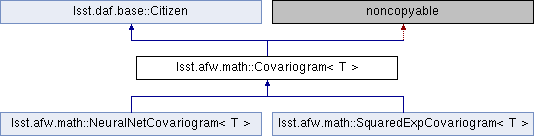
The parent class of covariogram functions for use in Gaussian Process interpolation. More...
#include <GaussianProcess.h>
Public Member Functions | |
| virtual | ~Covariogram () |
| Covariogram () | |
| construct a Covariogram assigning default values to the hyper parameters More... | |
| virtual T | operator() (ndarray::Array< const T, 1, 1 > const &p1, ndarray::Array< const T, 1, 1 > const &p2) const |
| Actually evaluate the covariogram function relating two points you want to interpolate from. More... | |
 Public Member Functions inherited from lsst.daf.base::Citizen Public Member Functions inherited from lsst.daf.base::Citizen | |
| Citizen (const std::type_info &) | |
| Citizen (Citizen const &) | |
| ~Citizen () | |
| Citizen & | operator= (Citizen const &) |
| std::string | repr () const |
| Return a string representation of a Citizen. More... | |
| void | markPersistent (void) |
| Mark a Citizen as persistent and not destroyed until process end. More... | |
| memId | getId () const |
| Return the Citizen's ID. More... | |
Additional Inherited Members | |
| Public Types inherited from lsst.daf.base::Citizen | |
| enum | { magicSentinel = 0xdeadbeef } |
| typedef unsigned long | memId |
| Type of the block's ID. More... | |
| typedef memId(* | memNewCallback )(const memId cid) |
| A function used to register a callback. More... | |
| typedef memId(* | memCallback )(const Citizen *ptr) |
| Static Public Member Functions inherited from lsst.daf.base::Citizen | |
| static bool | hasBeenCorrupted () |
| Check all allocated blocks for corruption. More... | |
| static memId | getNextMemId () |
| Return the memId of the next object to be allocated. More... | |
| static int | init () |
| Called once when the memory system is being initialised. More... | |
| static int | census (int, memId startingMemId=0) |
| How many active Citizens are there? More... | |
| static void | census (std::ostream &stream, memId startingMemId=0) |
| Print a list of all active Citizens to stream, sorted by ID. More... | |
| static const std::vector < const Citizen * > * | census () |
| Return a (newly allocated) std::vector of active Citizens sorted by ID. More... | |
| static memId | setNewCallbackId (memId id) |
| Call the NewCallback when block is allocated. More... | |
| static memId | setDeleteCallbackId (memId id) |
| Call the current DeleteCallback when block is deleted. More... | |
| static memNewCallback | setNewCallback (memNewCallback func) |
| Set the NewCallback function. More... | |
| static memCallback | setDeleteCallback (memCallback func) |
| Set the DeleteCallback function. More... | |
| static memCallback | setCorruptionCallback (memCallback func) |
| Set the CorruptionCallback function. More... | |
Detailed Description
template<typename T>
class lsst.afw.math::Covariogram< T >
The parent class of covariogram functions for use in Gaussian Process interpolation.
Each instantiation of a Covariogram will store its own hyper parameters
Definition at line 131 of file GaussianProcess.h.
Constructor & Destructor Documentation
|
virtual |
Definition at line 1821 of file GaussianProcess.cc.
|
inlineexplicit |
construct a Covariogram assigning default values to the hyper parameters
Definition at line 142 of file GaussianProcess.h.
Member Function Documentation
|
virtual |
Actually evaluate the covariogram function relating two points you want to interpolate from.
- Parameters
-
[in] p1 the first point [in] p2 the second point
Reimplemented in lsst.afw.math::NeuralNetCovariogram< T >, and lsst.afw.math::SquaredExpCovariogram< T >.
Definition at line 1824 of file GaussianProcess.cc.
The documentation for this class was generated from the following files:
- /home/lsstsw/stack/Linux64/afw/10.0-40-g4349866+2/include/lsst/afw/math/GaussianProcess.h
- /home/lsstsw/stack/Linux64/afw/10.0-40-g4349866+2/src/math/GaussianProcess.cc