#include <PyConverter.h>
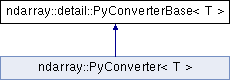
Inheritance diagram for ndarray::detail::PyConverterBase< T >:
Static Public Member Functions | |
| static bool | matches (PyObject *arg) |
| Check if a Python object might be convertible to T. More... | |
| static int | fromPython (PyObject *arg, T *output) |
| Convert a Python object to a C++ object. More... | |
Detailed Description
template<typename T>
struct ndarray::detail::PyConverterBase< T >
Definition at line 59 of file PyConverter.h.
Member Function Documentation
template<typename T>
|
inlinestatic |
Convert a Python object to a C++ object.
fromPython() is appropriate for use with the PyArg_ParseX Python C-API functions as a "O&" converter function.
- Returns
- true if the conversion was successful, and false otherwise (with a Python exception set).
- See Also
- PyConverter<T>::fromPythonStage1()
- PyConverter<T>::fromPythonStage2()
Definition at line 98 of file PyConverter.h.
static bool fromPythonStage2(PyPtr const &p, T &output)
Complete a Python to C++ conversion begun with fromPythonStage1().
boost::intrusive_ptr< PyObject > PyPtr
A reference-counting smart pointer for PyObject.
Definition: PyConverter.h:48
template<typename T>
|
inlinestatic |
Check if a Python object might be convertible to T.
- Returns
- true if the conversion may be successful, and false if it definitely is not. Will not raise a Python exception.
This is mostly useful for wrapper generators like SWIG or Boost.Python, which could use matches() to check if an Python arguments match a particular signature for an overloaded C++ function.
- See Also
- PyConverter<T>::fromPythonStage1()
Definition at line 75 of file PyConverter.h.
boost::intrusive_ptr< PyObject > PyPtr
A reference-counting smart pointer for PyObject.
Definition: PyConverter.h:48
The documentation for this struct was generated from the following file:
- /home/lsstsw/stack/Linux64/ndarray/10.0-1-g7408a83+3/include/ndarray/swig/PyConverter.h