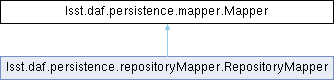
Inheritance diagram for lsst.daf.persistence.mapper.Mapper:
Public Member Functions | |
| def | __new__ (cls, *args, **kwargs) |
| def | __init__ (self, **kwargs) |
| def | __getstate__ (self) |
| def | __setstate__ (self, state) |
| def | keys (self) |
| def | queryMetadata (self, datasetType, format, dataId) |
| def | getDatasetTypes (self) |
| def | map (self, datasetType, dataId, write=False) |
| def | canStandardize (self, datasetType) |
| def | standardize (self, datasetType, item, dataId) |
| def | validate (self, dataId) |
| def | backup (self, datasetType, dataId) |
| def | getRegistry (self) |
Static Public Member Functions | |
| def | Mapper (cfg) |
Detailed Description
Mapper is a base class for all mappers.

Subclasses may define the following methods:

map_{datasetType}(self, dataId, write)
    Map a dataset id for the given dataset type into a ButlerLocation.
    If write=True, this mapping is for an output dataset.

query_{datasetType}(self, key, format, dataId)
    Return the possible values for the format fields that would produce
    datasets at the granularity of key in combination with the provided
    partial dataId.

std_{datasetType}(self, item)
    Standardize an object of the given data set type.

Methods that must be overridden:

keys(self)
    Return a list of the keys that can be used in data ids.

Other public methods:

__init__(self)

getDatasetTypes(self)

map(self, datasetType, dataId, write=False)

queryMetadata(self, datasetType, key, format, dataId)

canStandardize(self, datasetType)

standardize(self, datasetType, item, dataId)

validate(self, dataId)
Constructor & Destructor Documentation
◆ Mapper()
|
static |
Instantiate a Mapper from a configuration.
In come cases the cfg may have already been instantiated into a Mapper, this is allowed and
the input var is simply returned.

:param cfg: the cfg for this mapper. It is recommended this be created by calling
            Mapper.cfg()
:return: a Mapper instance
Definition at line 71 of file mapper.py.
71 def Mapper(cfg):
72 '''Instantiate a Mapper from a configuration.
73 In come cases the cfg may have already been instantiated into a Mapper, this is allowed and
74 the input var is simply returned.
75
76 :param cfg: the cfg for this mapper. It is recommended this be created by calling
77 Mapper.cfg()
78 :return: a Mapper instance
79 '''
80 if isinstance(cfg, Policy):
81 return cfg['cls'](cfg)
82 return cfg
83
◆ __init__()
| def lsst.daf.persistence.mapper.Mapper.__init__ | ( | self, | |
| ** | kwargs | ||
| ) |
Reimplemented in lsst.daf.persistence.repositoryMapper.RepositoryMapper.
Definition at line 100 of file mapper.py.
100 def __init__(self, **kwargs):
101 pass
102
Member Function Documentation
◆ __getstate__()
| def lsst.daf.persistence.mapper.Mapper.__getstate__ | ( | self | ) |
◆ __new__()
| def lsst.daf.persistence.mapper.Mapper.__new__ | ( | cls, | |
| * | args, | ||
| ** | kwargs | ||
| ) |
Create a new Mapper, saving arguments for pickling.

This is in __new__ instead of __init__ to save the user
from having to save the arguments themselves (either explicitly,
or by calling the super's __init__ with all their
*args,**kwargs.  The resulting pickling system (of __new__,
__getstate__ and __setstate__ is similar to how __reduce__
is usually used, except that we save the user from any
responsibility (except when overriding __new__, but that
is not common).
Definition at line 84 of file mapper.py.
84 def __new__(cls, *args, **kwargs):
85 """Create a new Mapper, saving arguments for pickling.
86
87 This is in __new__ instead of __init__ to save the user
88 from having to save the arguments themselves (either explicitly,
89 or by calling the super's __init__ with all their
90 *args,**kwargs. The resulting pickling system (of __new__,
91 __getstate__ and __setstate__ is similar to how __reduce__
92 is usually used, except that we save the user from any
93 responsibility (except when overriding __new__, but that
94 is not common).
95 """
96 self = super().__new__(cls)
97 self._arguments = (args, kwargs)
98 return self
99
◆ __setstate__()
| def lsst.daf.persistence.mapper.Mapper.__setstate__ | ( | self, | |
| state | |||
| ) |
◆ backup()
| def lsst.daf.persistence.mapper.Mapper.backup | ( | self, | |
| datasetType, | |||
| dataId | |||
| ) |
Rename any existing object with the given type and dataId.

Not implemented in the base mapper.
Definition at line 191 of file mapper.py.
191 def backup(self, datasetType, dataId):
192 """Rename any existing object with the given type and dataId.
193
194 Not implemented in the base mapper.
195 """
196 raise NotImplementedError("Base-class Mapper does not implement backups")
197
◆ canStandardize()
| def lsst.daf.persistence.mapper.Mapper.canStandardize | ( | self, | |
| datasetType | |||
| ) |
Return true if this mapper can standardize an object of the given
dataset type.
Definition at line 167 of file mapper.py.
167 def canStandardize(self, datasetType):
168 """Return true if this mapper can standardize an object of the given
169 dataset type."""
170
171 return hasattr(self, 'std_' + datasetType)
172
◆ getDatasetTypes()
| def lsst.daf.persistence.mapper.Mapper.getDatasetTypes | ( | self | ) |
◆ getRegistry()
| def lsst.daf.persistence.mapper.Mapper.getRegistry | ( | self | ) |
◆ keys()
| def lsst.daf.persistence.mapper.Mapper.keys | ( | self | ) |
◆ map()
| def lsst.daf.persistence.mapper.Mapper.map | ( | self, | |
| datasetType, | |||
| dataId, | |||
write = False |
|||
| ) |
Map a data id using the mapping method for its dataset type.

Parameters
----------
datasetType : string
    The datasetType to map
dataId : DataId instance
    The dataId to use when mapping
write : bool, optional
    Indicates if the map is being performed for a read operation
    (False) or a write operation (True)

Returns
-------
ButlerLocation or a list of ButlerLocation
    The location(s) found for the map operation. If write is True, a
    list is returned. If write is False a single ButlerLocation is
    returned.

Raises
------
NoResults
    If no locaiton was found for this map operation, the derived mapper
    class may raise a lsst.daf.persistence.NoResults exception. Butler
    catches this and will look in the next Repository if there is one.
Definition at line 137 of file mapper.py.
137 def map(self, datasetType, dataId, write=False):
138 """Map a data id using the mapping method for its dataset type.
139
140 Parameters
141 ----------
142 datasetType : string
143 The datasetType to map
144 dataId : DataId instance
145 The dataId to use when mapping
146 write : bool, optional
147 Indicates if the map is being performed for a read operation
148 (False) or a write operation (True)
149
150 Returns
151 -------
152 ButlerLocation or a list of ButlerLocation
153 The location(s) found for the map operation. If write is True, a
154 list is returned. If write is False a single ButlerLocation is
155 returned.
156
157 Raises
158 ------
159 NoResults
160 If no locaiton was found for this map operation, the derived mapper
162 catches this and will look in the next Repository if there is one.
163 """
164 func = getattr(self, 'map_' + datasetType)
165 return func(self.validate(dataId), write)
166
◆ queryMetadata()
| def lsst.daf.persistence.mapper.Mapper.queryMetadata | ( | self, | |
| datasetType, | |||
| format, | |||
| dataId | |||
| ) |
Get possible values for keys given a partial data id.

:param datasetType: see documentation about the use of datasetType
:param key: this is used as the 'level' parameter
:param format:
:param dataId: see documentation about the use of dataId
:return:
Definition at line 114 of file mapper.py.
114 def queryMetadata(self, datasetType, format, dataId):
115 """Get possible values for keys given a partial data id.
116
117 :param datasetType: see documentation about the use of datasetType
118 :param key: this is used as the 'level' parameter
119 :param format:
120 :param dataId: see documentation about the use of dataId
121 :return:
122 """
123 func = getattr(self, 'query_' + datasetType)
124
125 val = func(format, self.validate(dataId))
126 return val
127
◆ standardize()
| def lsst.daf.persistence.mapper.Mapper.standardize | ( | self, | |
| datasetType, | |||
| item, | |||
| dataId | |||
| ) |
Standardize an object using the standardization method for its data
set type, if it exists.
Definition at line 173 of file mapper.py.
173 def standardize(self, datasetType, item, dataId):
174 """Standardize an object using the standardization method for its data
175 set type, if it exists."""
176
177 if hasattr(self, 'std_' + datasetType):
178 func = getattr(self, 'std_' + datasetType)
179 return func(item, self.validate(dataId))
180 return item
181
◆ validate()
| def lsst.daf.persistence.mapper.Mapper.validate | ( | self, | |
| dataId | |||
| ) |
Validate a dataId's contents.

If the dataId is valid, return it.  If an invalid component can be
transformed into a valid one, copy the dataId, fix the component, and
return the copy.  Otherwise, raise an exception.
Definition at line 182 of file mapper.py.
182 def validate(self, dataId):
183 """Validate a dataId's contents.
184
185 If the dataId is valid, return it. If an invalid component can be
186 transformed into a valid one, copy the dataId, fix the component, and
187 return the copy. Otherwise, raise an exception."""
188
189 return dataId
190
The documentation for this class was generated from the following file:
- /j/snowflake/release/lsstsw/stack/lsst-scipipe-5.0.1/Linux64/daf_persistence/g17e5ecfddb+50a5ac4092/python/lsst/daf/persistence/mapper.py